Poetry to Say Hard Things
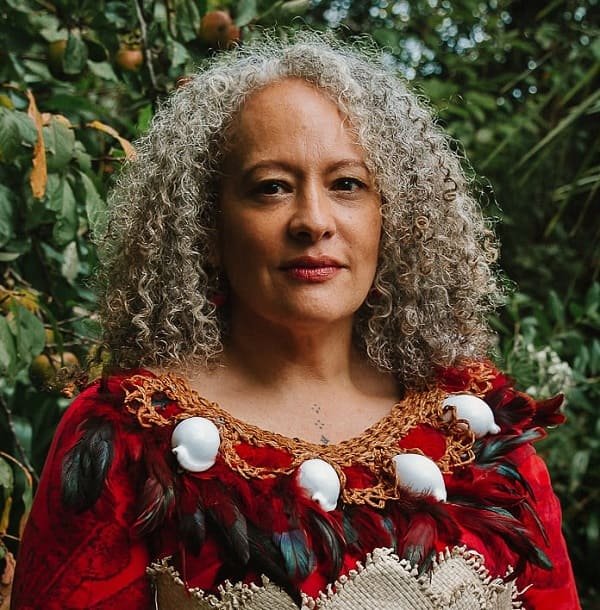
Por: Karlo Mila
I wish to begin this essay by acknowledging Dr Elba Ramirez for kindly translating my work into Spanish. I am so grateful. This is the first time to have my work translated into Spanish and it feels very special. I have deliberately chosen a wide range of poems focusing on different topics and tones that speak to different aspects of life that I write about.
I believe that as poets, we are able to use language very concisely and emotively in ways that can offer clarity and a sense of solidarity to others who are suffering. Not just to provide solidarity of experience but also liberate to us.
I will use poetry to say hard things and speak truth to power. This is very evident in ‘Trauma Bombs’ which was written at the South Pacific Festival of the Arts and performed in Hawai’i. This confronts the history of colonialization in the Pacific region and links it to contemporary racist thought.
I have another, similar long poem (not included in the translations) that was read at the Commonwealth Heads of Government Community Forum in 2019. An academic, Matthew Waites wrote, of the Commonwealth event: “An astonishing moment came when the poet Karlo Mila—of Tongan, Samoan and European heritage and from New Zealand (Poetry Foundation, 2022)—was invited to speak immediately after Theresa May and Bill Gates; the audience suddenly intent:
Indeed, we’ve entered this / strange garden / in this city, / epicentre of epitaph, /
epitome of empire. / The stones in the squares / remind us / that we all died for this. / The war memorials murmur / numbers not names. / We bring our dead with us /
and they are already here. / Not just the ones marked by marble. / But our ancestors, / the original inhabitants / of the lands ‘discovered’. / Who lie in the unmarked graves / and unmentioned massacres, / in battles unspoken of /
in untaught wars / We carry them like stones / in our bodies. / They too contribute towards this commonwealth. / (Mila, 2020, pp. 185-188) (Waites, 2024, p. 223-224).
More recently, I have found myself writing poetry about the Doctrine of Discovery. The United Nations explains that this is the Doctrine which, “by law and divine intention, European Christian countries gained power and legal rights over indigenous non-Christian peoples immediately upon their “discovery” by Europeans”.
Coming to Columbia, I was very tempted to write a poem about ‘El Requerimiento’ the Spanish requirement of 1513. Its text is so shocking to me:
“… We shall powerfully enter into your country, and shall make war against you in all ways and manners that we can, and shall subject you to the yoke and obedience of the Church and of their Highnesses; we shall take you and your wives and your children, and shall make slaves of them, and as such shall sell and dispose of them as their Highnesses may command; and we shall take away your goods, and shall do you all the mischief and damage that we can, as to vassals who do not obey, and refuse to receive their lord, and resist and contradict him; and we protest that the deaths and losses which shall accrue from this are your fault, and not that of their Highnesses, or ours, nor of these cavaliers who come with us.”
When I read this, I can see the source of racism that has an enduring legacy and continuing energy. I see how this racism becomes internalized (by design) whereby the fault is found within. It brings me such pain and yet it sets me so free. I am empowered by understanding this painful legacy, because it gives me enough information to grant me understanding. Then it cannot harm me without me knowing how or why. The poem Trauma Bombs speaks to incidents that have happened in Oceania that collectively and cumulatively create a legacy of trauma, dispossession and dehumanisation. I believe that tracing genealogies back to source wounds is part of our healing.
I have included the poem “Treaty Principles Bill” in this collection which was read at parliament as part of a Select Committee process. It was an oral submission to the government opposing the Treaty Principles Bill. Even though it contains many unfamiliar New Zealand-specific references, I hope it can be read in the context of similar struggles.
Te Tiriti o Waitangi was signed between the British Crown and Māori leaders in 1840 to set in place clear agreements about how the settlers and indigenous people could co-exist cooperatively and peacefully. This agreement was dishonoured, disregarded and even nullified by the New Zealand government once the settler population outnumbered Māori. However, our indigenous people have worked tirelessly and intergenerationally in multiple ways and on multiple fronts for this Treaty to hold its rightful place as the foundational covenant of this nation. It is a constitutional document that sets the agenda and expectations for how this nation will operate and it outlines the rights and responsibilities of all who live here.
In 1975, a government tribunal was formed to listen to historical facts and breaches of the Treaty. They had the power to admit fault, apologise, and make reparations in the spirit of repair and justice. These reparations cannot fully address the harm caused and come nowhere near the current value of what was taken. Yet, there has been a political backlash, considerable misinformation, wilful ignorance and fearmongering. Racism has been exploited by politicians who perceive accurately that indigenous rights will block corporate exploitation of our natural resources and puts barriers in the way of selling off our collectively owned state assets.
It has been a politically brutal time to live in Aotearoa. The poem, “The Sensitive Ones are Going Down’ speaks to this suffering. In 2025, I edited a free community e-book called ‘Fighting Words for Despairing Times’ launched at Waitangi on Waitangi Day that gathers Māori and Pacific poetic voices about this experience. You can access a free copy by emailing: fightingwords2025@gmail.com
Much of my writing has tried to educate in ways that shares valuable - but often hidden - or marginalised information that can empower us to see ourselves in socio-historical context. I know that I have a role as a poet, to use my voice and use the medium of poetry to educate, conscientize, raise awareness and to participate politically in times where there is so much misinformation. We all have short attention spans. Poetry can condense dense history into a few cutting lines that can make their mark quickly and powerfully.
Even though I have not included poems on climate crisis here, I have used poetry as a way of communicating science and facts that people might not otherwise want to know. I have written and curated digital poetry films called, “Pacific Voices” that were part of a Mana Moana Arts Collective and were sent to COP26 in Edinburgh. It feels like part of my job as a poet. https://www.pasifikavoices.com/
We are living in a time of polycrises in the collapse of modernity. We are inheriting crumbling and unsustainable systems of extraction, exploitation and separation that de-enliven the natural world and dehumanize each other. It is not easy to live in the Anglosphere – in Oceania - that has disregarded the indigenous wisdom and ways of knowing that have gestated here for millennia. This could have been my birthright. But so much of it has been systematically destroyed, dismantled demonized and devalued.
Much of my poetry speaks to the power of indigenous ways of being and seeing the world and the power of returning to ancestral Oceanic intelligence. I see with clarity that the Western orthodox worldview is out of ideas for sustainable ways forward into a peaceful and balanced future.
For many years I have studied the indigenous languages of the part of the Pacific that I come from. I have dedicated my career to vitalizing indigenous knowledge specific to the region of Oceania, particularly my ancestral islands of Tonga and Samoa.
Following a formula inspired by Paulo Freire, my postdoctoral research involved systematically collecting defining cultural concepts and archetypes, related proverbial knowledge and defining narratives and working with artists and elders to bring it back into our everyday worlds. I sought the threads of similar philosophies, ethics, and ethos found across the islands of Oceania. Carefully consulting the Pacific communities that I am a part of, we systematically reweaved these threads into an accessible basket of knowledge containing images, research, and translations for people seeking connection with our cultural legacy. With psychologists and experienced leadership facilitators, we operationalized this into Pacific leadership, professional development and health and wellbeing programmes that have been run for many years. The hope is to awaken and harness ancestral understanding into our everyday professional and personal worlds. This endeavour and movement – called Mana Moana - profoundly influences my creative work. https://www.manamoana.org.nz/
From my very first poetry book, I’ve been described as a Polyglot. In my poetry, I draw regularly on multiple indigenous languages from across Oceania because there is no equivalent or ‘right word’ in English. The poem ‘Mana’ in this collection is entirely about how hard it is to translate this word into English. It means so much more than what any English word can fully convey. And it is connected to another way of knowing the world where different things are both possible and probable.
This other universe – the one informed by Oceanic intelligence – is always rippling in the way I see the world. Even in the ‘Distillers Guide to Poetry’ which is not particularly cultural in focus, I reference the ‘ihu’ (the nose) of the land and how once you see it, you cannot un-see it. This references the enlivened, ensouled and biosentient natural world that our ancestors framed as our relatives. It speaks to stories beyond our understanding, the transcendent and the great mystery that is so far beyond the grasp of human understanding.
the way / something that you can’t see, / is inhaling everything in, / all the time.
Other poems in this collection do similar work: “Your people will gather around you” and “The Field”. This indigenous multidimensionality and view of the world is completely at odds with the secular scientific materialism that I learned at school in Aotearoa / New Zealand. But for me, it is incredibly life-giving.
My own life experiences – since I was very young – have involved encounters with another realm that can only be interpreted by Western knowledge systems as pathology, fantasy or blasphemy. Yet my ancestral knowledge system had language and knowledge paradigms that could make sense of my experiences grounded in another epistemology.
Being pathologized by the medical model, being misdiagnosed, being forcefully treated with the wrong medicines and in ways that reduced the potential fullness of my life has been very hard. I know that this has happened to many other people. Some experiences are so painful and complex that I can only speak about them using poetry. I have included two poems for my sons in this collection that speak to some of these ‘hard’ experiences. They are the only poems that I’ve written for my boys since they were born, and yet they appear to me to hold a whole lifetime of feelings. That’s the gift of poetry.
The final work in this translated collection is an ode to the gift of poetry. ‘The Distillers Guide to Poetry’ captures what poetry means to me and how it operates in my life. We had some trouble with the Spanish translation because the word ‘spirits’ has a double meaning in English (meaning both liquor and the spiritual). This double-meaning feels vital to the poem because for me poems are like spirits. Poems have their own ‘mauri / mauli’ or spiritual essence that carries a unique energetic imprint in the world.
All of these poems carry some of my mauli, and they have their own. I offer them to you in a spirit of loving generosity. It is perhaps an unusual assortment of poems – but they are some of my favourites. It is so hard to choose only twenty. I have thrown some love poems in for balance. Each poem is a part of a much bigger story. I hope from this collection you will have a sense of my own story, and I hope that it will resonate with yours. Gracias, Mālō ‘aupito.
Dr Karlo Mila is an award-winning poet, writer, mother, activist and researcher. She is the author of three books of poetry, including Dream Fish Floating (2005) which won the Jessie MacKay Best First Book of Poetry at the 2006 Montana New Zealand Book Awards. Her most recent book, Goddess Muscle, was released by Huia Publishers in 2020.
She is of Tongan and Pākehā descent, with ancestral connections to Samoa. Born and raised in Aotearoa, New Zealand, her poetry and professional career has focused on the realities of Pasifika identity, love, life and the politics of relationships. In 2019, Karlo was awarded a MNZM for services to the Pacific community and as a Poet. She was the winner of the CNZ Contemporary Pacific Artist Award in 2016.
Career highlights include representing Tonga at the 2012 Cultural Olympiad event Poetry Parnassus Festival in London, a Fulbright Creative Writing Residency in Hawai’i and reading poetry at the Commonwealth Heads of Government Meeting Peoples Forum in 2018.