Writing Poetry Is Therapy
Por: Lana Derkač
Writing poetry is therapy which empowers us to persist in bearing all the tiny individual or the great and global images of this world, transforming them into swarms of silly and multiplied metaphors, similes, onomatopoeias, personifications and other stylistic devices. Because we continually and almost regularly, without either consent or agreements signed, bear the erratic sky and unfavourable mental prognosis, the tidal wave of mind-blowing demands that have been placed upon us anew and that overwhelm all our relief. We still bear the unrecycled stress accumulated in front of a television set overtaken by illogic and idiocy, the alliances which we both are and are not a member of, the extortionists of futility or the amatory sighs of monotony as an occasional partner.
Every poet practising writing as potential therapy is more than aware that he has never consented personally to bear tribulation, let alone to breed affliction, although he can discern that some kind of an agreement has been signed between affliction and poetry. He perceives the possibility of compensation. Moreover, he knows that for his poetic text this Sisyphean rolling of affliction as a stone is not entirely wasted, futile. And so poetry can give new meaning to Sisyphus-the poet. He was punished only to be awarded since the gods have great plans for him and his punishment is neither the last measure nor the gods’ final plan.
One contradiction emerges here. More specifically, a fanatic and nonpragmatic being suddenly derives profit from the affliction he found himself in, from which it follows that the poet possesses the incredible capacity for practicality and management. However, this management capacity is not economic in nature since it computes only spiritual incomes and expenditures. The poet is capable of deriving enormous profit from personal loss and the unsuccessful transport of a Sisyphean stone, without registering a large enterprise. But literature loves paradoxes.
It is a fact that writing is an attempt at adaptation since, by writing and indirectly explaining and substantiating the world, we are, in fact, trying to understand it and find our place in it. But faced with our very own traumas and disapproval, we are also witnesses to an extra-textual disease inside us. Curiously, it is we who lay behind this disease, while it was, although not immediately recognisably, smiling and posing for a photo shoot like a bride. The emergence itself of the disease, provoked by a persistent and inevitable, yet inadvertent experience of reality, does not depend on the text, although the text both depends on and is conditioned by it.
It is precisely here and now that the pharmaceutics of text and writing as therapy rise. Owing to his text, the poet loses his sense of being a loser, starts feeling well, and strengthens his immunity with the help of emotional fullness and short-term spiritual satiety.
Here lies yet another surprise! The disease, whose birthing does not depend on the text, is nevertheless conditioned by it. Having acknowledged its unwelcome cells and conquering nature, the text itself becomes its conqueror. And so having resourcefully taken over its power, the text psychologically heals the author – its own creator.
Writing poetry or any other literary text is the exact opposite of suicide.
Precisely at the moment when conventional and agreed letters spread fully unconventionally across the blankness of paper as the implausibility of emptiness in the overcrowded realm of emotionality, at that very moment, suddenly, pen and paper inexplicably and alchemically begin to be inscribed into the ingredients of those immaterial pills on the invisible pages of medicine. All of a sudden they acquire healing properties.
In pact with pen and paper or a computer keyboard, the author speaks of minute details, and is preoccupied with insignificant and impractical objects which are immensely important to him and which are frequently distinguished by beings. These details occupy his emotional realm determinedly. Incredibly convincing, although without any intention of accentuating either self-possession or superiority. Which is why the writer believes them.
Placing these details into unusual associations, which would be interpreted as delirium if expressed in public places, are slowly becoming inspired poetry which floats beside conventional institutions such as banks, airports, schools or courts of justice. And hospitals as well. And when a shift ends, doctors in white coat uniform are replaced by other doctors, whose constitution, as well as DNA, is difficult to determine because authors can ascribe a new shape to them at any moment inscribing new letters in the eternally open Book of Genesis.
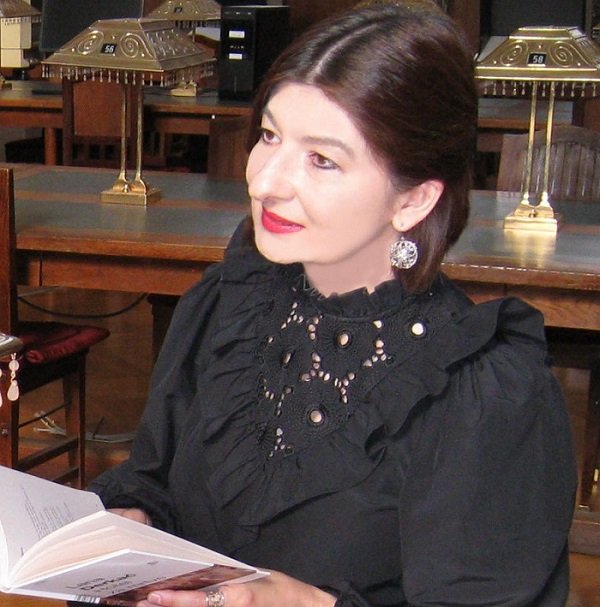
Lana Derkač (1969) is a prominent, award-winning Croatian writer. She nurtures a very peculiar style of writing, combining the modernistic with the postmodernistic poetic discourse, intimacy with global apocalyptic phenomena endangering intimacy with astonishment at clips of reality. She talks of nature, the phenomenon of globalised world, ancient and contemporary urban mythology, virtual information space, apocalyptic world crises, deviant social relationships, incompatible people in love, and creative yet anxious inner worlds. She graduated from the University of Zagreb, Faculty of Philosophy. She has published some fifteen collections of poetry, prose, drama, essays and a novel in Croatia. Her work was published in a large number of Croatian and international newspapers, magazines and anthologies, It has been translated into 20 languages. She was awarded Zdravko Pucak Poetry Prize, Duhovno Hrasce Prize and Vinum et poeta Prize in Croatia and the Risto Ratkovic Award in Montenegro for the best poetry book in the region.